Driver Identification
Drivers authenticate at the terminal against their licence record. Howen's on-device face recognition can be enabled where a jurisdiction wants the driver checked against the licence rather than a PIN.

Mobile Data Terminal
The certified terminal fitted in the vehicle. It carries Driver Companion, connects the regulated meter, verifies driver identity and produces the position trail an authority can rely on. Tanzim builds the MDT on hardware from Howen Technologies.
An authority can mandate metered fares, verified drivers and recorded routes. None of it holds up unless the equipment in the vehicle is tamper evident and the data it produces can be trusted in a dispute.
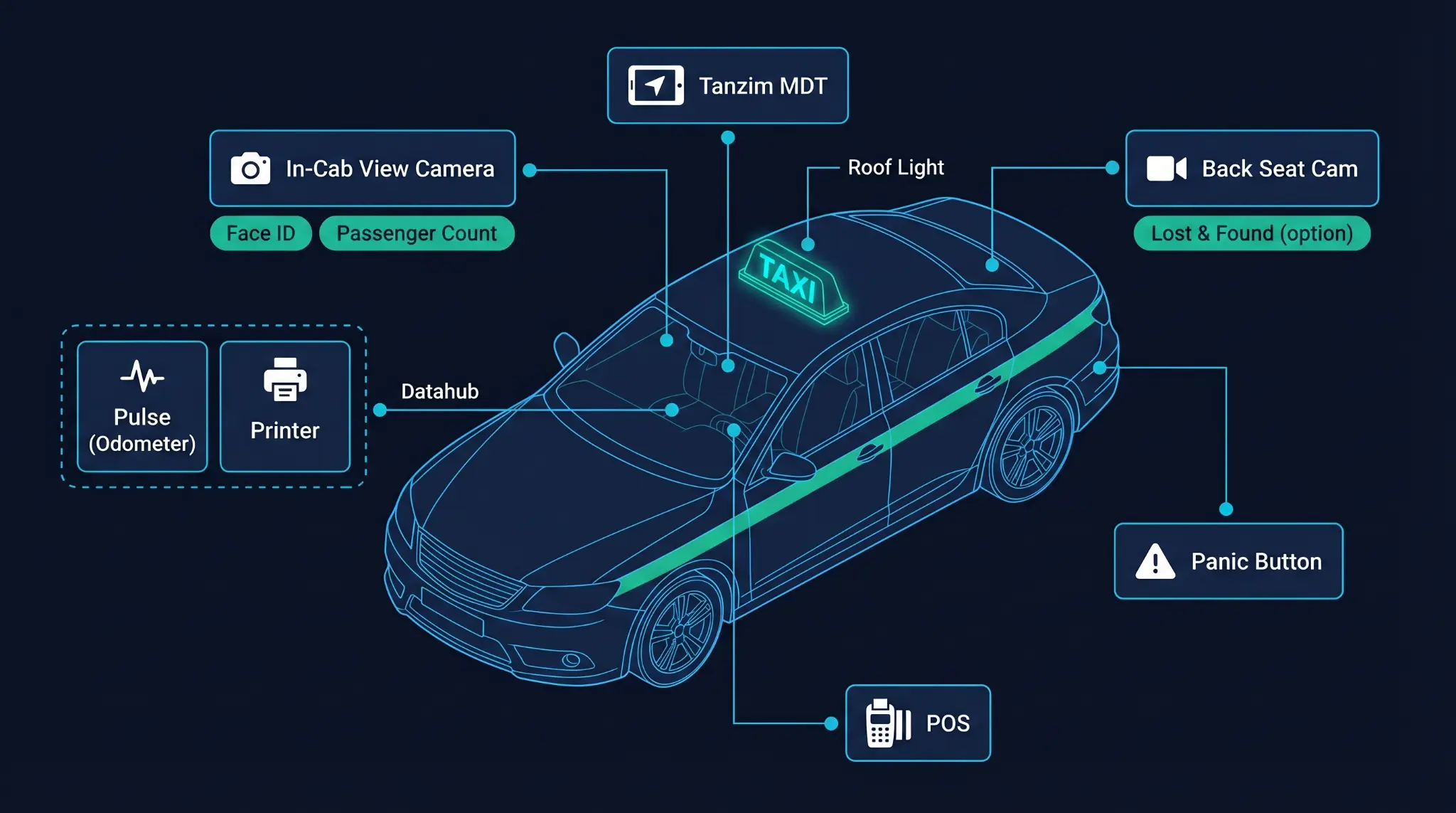

Howen Technologies is our in-vehicle hardware partner. The Tanzim MDT is built on their AT5 V5 terminal: an Android device with a bright IPS display, multi-mode satellite positioning, dual-band wireless, a hot-swappable SIM and a six-axis motion sensor.
Howen states the AT5 V5 is OIML certified by NMi, the international legal metrology standard, with MID certification for European markets. Where a jurisdiction requires type approval for the fare measurement path, that is the certification it rests on.
The functions that have to be physically present in the vehicle, rather than assumed from a driver's phone.
Drivers authenticate at the terminal against their licence record. Howen's on-device face recognition can be enabled where a jurisdiction wants the driver checked against the licence rather than a PIN.
A monitored connection to the regulated meter, including the pulse input used for mileage and fare calculation. If the link is interrupted, the interruption itself becomes part of the record.
Continuous satellite positioning from vehicle-mounted equipment, producing a route record that can be used to settle a fare dispute.
Housing, power and connection state monitored. Removal, disconnection and power loss are logged and reported rather than passing unnoticed.
Ignition, odometer and CAN bus data through Howen's DataHub, supporting utilisation reporting and maintenance scheduling.
Cellular data with local storage, so operation continues through coverage gaps and the record reconciles on reconnection.
Where an authority mandates in-vehicle recording, camera channels are supported and retained under the authority's own retention policy.
Software delivered over the air to vehicles in service, with staged rollout so a fleet is never updated all at once.
Deployment
Hardware programmes are where mobility projects usually slip. These are the practical points we expect to be asked about.
Works with
Fitting requirements differ by jurisdiction and vehicle class. Send us your specification and we will confirm what the terminal supports.
Praxis
Online