In-Vehicle Hardware
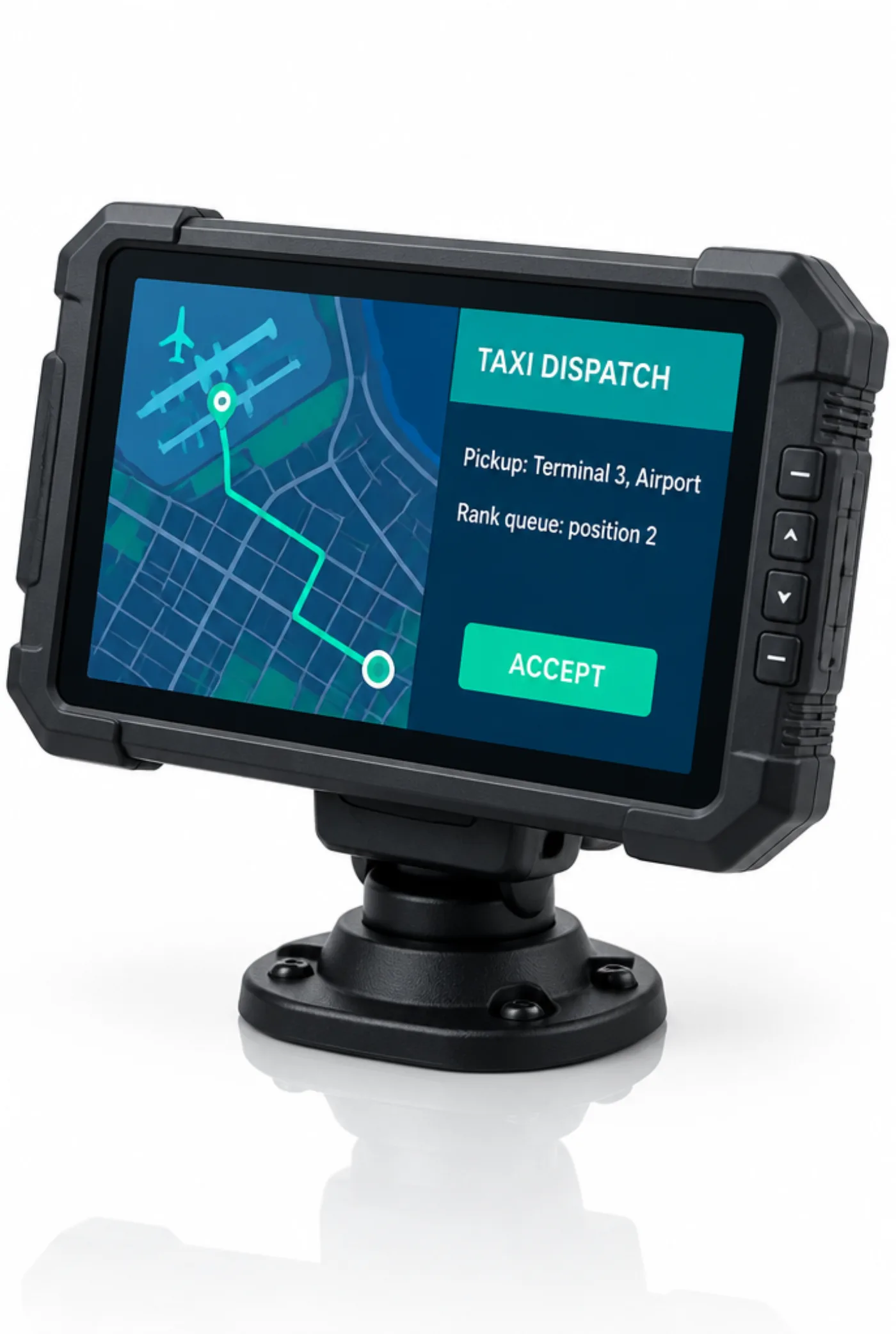
Terminals, meters, printers and recording equipment. Howen supplies the Tanzim MDT; existing equipment meeting the authority's specification can be connected instead.

Technology Partners
A transport authority already runs payment systems, ticketing infrastructure, licensing databases and vehicle equipment. Tanzim is built to connect to them rather than to replace them, and we name the partners we depend on.

Howen is Tanzim's in-vehicle hardware partner. They build AI video telematics and mobile data terminals for commercial fleets, and their AT5 V5 taxi terminal is the basis of the Tanzim MDT.
The partnership covers hardware supply, firmware integration and regional service support. It matters for procurement because an authority has to keep a fitted fleet supported for the length of a concession, not for the length of a product cycle.
Legal metrology
Howen states that the AT5 V5 terminal is OIML certified by NMi, the international legal metrology standard that fare measurement is assessed against, with MID certification for European markets. Where a jurisdiction requires type approval for the metering path, this is the certification it rests on.
In service today
Howen reports its MDT solution in service with Mowasalat, which operates Qatar's Karwa taxi and bus network, connected to vehicle systems over CAN bus and supporting the pulse input used for mileage and fare calculation. That deployment is Howen's, not ours, and we cite it as evidence about the hardware rather than about Tanzim.
What the platform runs on
An Android terminal with a bright IPS display, multi-mode satellite positioning, dual-band wireless, hot-swappable SIM and a six-axis motion sensor. Howen's driver identity, passenger counting and lost-property detection run on the device alongside Driver Companion.
Every category below is an integration point, not a replacement programme. Existing contracts and existing infrastructure stay where they are.
Terminals, meters, printers and recording equipment. Howen supplies the Tanzim MDT; existing equipment meeting the authority's specification can be connected instead.
Card acquiring, digital wallets and national payment schemes, connected through the authority's existing banking arrangements rather than ours.
Automated fare collection and public transport ticketing, so a taxi leg can be priced and settled alongside the rest of a journey.
Commercial and open mapping, with the ability to run against a national mapping authority's data where one exists.
National identity systems and existing licensing databases, so driver and vehicle records are checked against the register of record.
Vehicle tracking and telematics already fitted to a fleet, connected rather than duplicated by a second device.
Ministry reporting, traffic management and emergency services interfaces, built to the authority's specification.
Documented interfaces for the authority's own developers and for third parties the authority chooses to admit.
Open interfaces
Most authorities already run a passenger app and a public website. Tanzim dispatch sits behind a documented API so those channels keep working and keep their own identity, while the allocation and the record move to the authority.
A booking made through your channel produces the same trip record as one made through ours, so oversight does not depend on which front door the public used.
How this works for passenger appsWhat your own channels can do
Integration posture
Integration commitments are easy to make and expensive to keep. These are the ones we are prepared to write into a contract.
The integration conversation is more useful than the feature conversation. Send us your current systems and we will tell you what connects and what does not.
Praxis
Online